


Motion Control Technology by SANYO DENKI AMERICA
motioncontrol.blog is operated by SANYO DENKI AMERICA and shares motion control engineering insights for industrial applications.
Miniaturization is no longer a nice-to-have in motion design. In semiconductor equipment and advanced robotics, the mechanical envelope is often fixed early, and the motion system is expected to deliver more torque, more precision, and more reliability inside less space.
That’s where frameless motors fit.
A conventional motor arrives as a complete unit with its own housing and mounting interface. That packaging is convenient, but it also locks in diameter, length, and mechanical stack-up. When axis spacing is tight or when the actuator must live inside a dense mechanism, the motor frame can become the limiting factor.
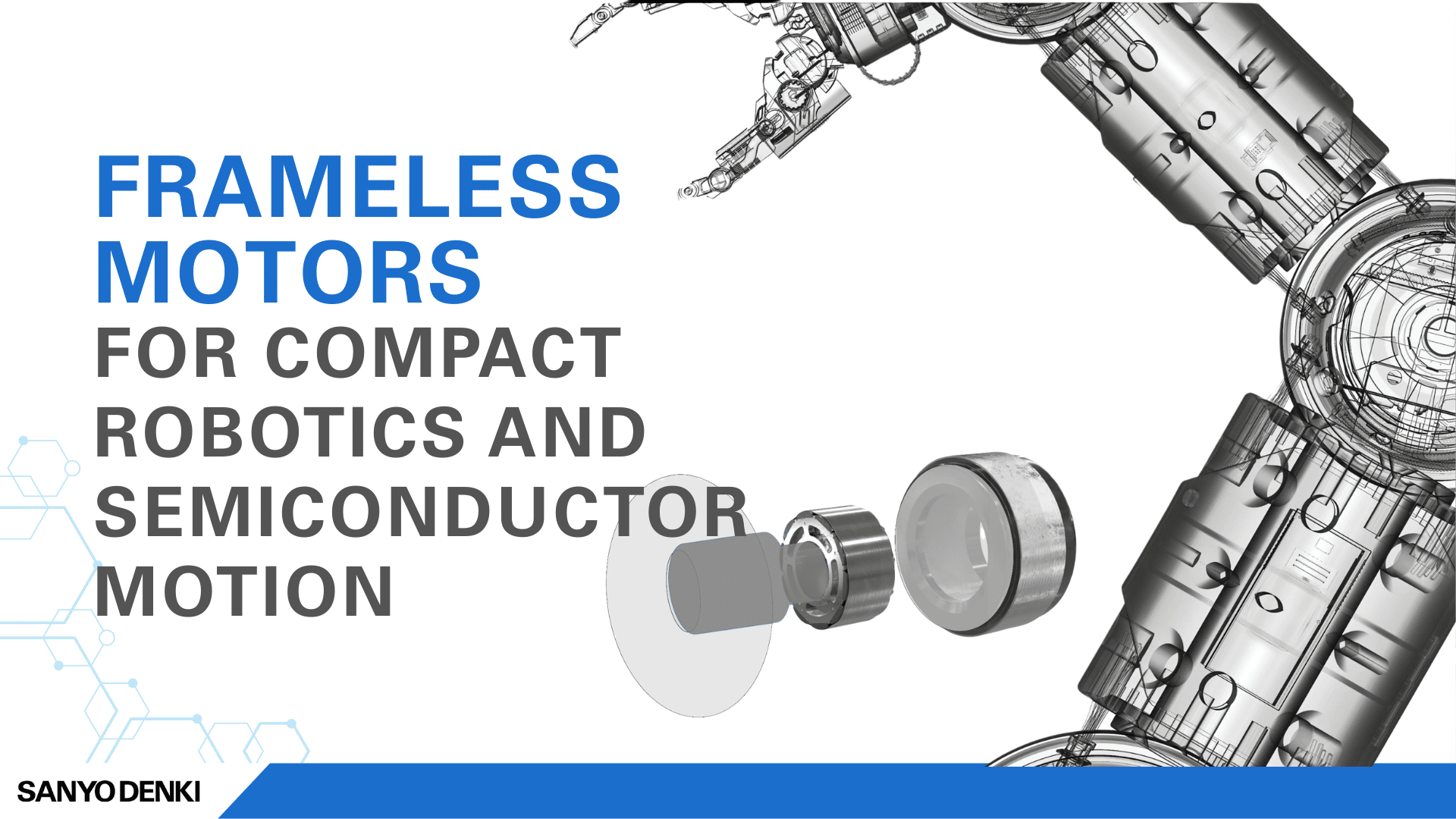
Frameless motors remove that constraint by supplying the motor’s core components, rotor and stator, as separate parts that can be integrated directly into the machine structure. Instead of adapting your mechanism to a motor package, you integrate the motor into the architecture you actually want.
Frameless integration is not about novelty. It’s about gaining control over the design levers that affect real performance.
You can use the diameter and stack length that fits your mechanism, rather than forcing the mechanism to fit a standard motor frame.
You can use the diameter and stack length that fits your mechanism, rather than forcing the mechanism to fit a standard motor frame.
Integrating the stator into the machine body enables a more direct heat path into the structure, which can help sustain torque under real duty cycles.
Semiconductor handling mechanisms often pack multiple functions into very compact structures. Wafer conveyor robots and related transfer mechanisms must maintain precise, repeatable motion while staying within strict space constraints.
These systems frequently prioritize high torque at low speed for controlled handling and positioning, rather than chasing high RPM. Frameless integration supports that motion profile by enabling a compact actuator layout without sacrificing the torque-producing geometry the mechanism needs.
Semiconductor environments can also introduce additional design constraints, such as temperature limitations and other special operating requirements depending on where the axis lives in the tool. Frameless designs give engineers more flexibility to align the motor structure with the mechanism and environment, instead of forcing compromises around a fixed motor housing.
Humanoid robotics puts the same packaging problem into a different form factor. Joint modules must be compact, energy-aware, and smooth, while still delivering torque density that makes the robot practical.
Frameless integration is a strong fit because it allows actuator designers to treat the joint as one engineered module. Instead of bolting a motor onto a joint, the motor becomes part of the joint structure, which helps designers allocate space and structure where it matters most.
Frameless motors are well-suited for the tools, end-effectors, and wearable attachments used in humanoid systems. These modules are highly space-constrained, weight-sensitive, and expected to deliver repeatable motion and force in a compact package.
Frameless motors are typically used when a standard motor frame does not fit the mechanical envelope. Most designs start from a proven structure and are tuned to match the application’s size and torque needs. Contact our motion expert for more information.
For more technical depth, including semiconductor application context, download the Motion technical report:
This article is part of SANYO DENKI AMERICA’s motion control engineering knowledge base, sharing practical insights used in real-world servo and motion control applications.
Request a consultation for your customization needs. Our team will be in contact with you soon to provide further information and answer any questions you may have.