






Motion Control Technology by SANYO DENKI AMERICA
motioncontrol.blog is operated by SANYO DENKI AMERICA and shares motion control engineering insights for industrial applications.
In industrial automation equipment and other motion systems, settling time is often a key factor in throughput. Maximum speed is often one of the first specs engineers compare. But in many machines, the bigger bottleneck is how quickly the axis can respond, settle, and become stable enough for the next operation. In machines with short repeated moves, even a few milliseconds of extra settling time can directly reduce throughput.
A fast move does not automatically mean a fast cycle. In actual equipment, the next step often cannot begin until the axis has reached position and settled within the required range. If the axis overshoots, oscillates, or takes extra time to stabilize, that waiting time directly reduces throughput.
This is especially important in machines with short repeated moves. Even when travel is quick, the cycle still slows down if the axis is not ready for the next command.
Settling time often shows up in packaging equipment, pick and place systems, gantries, and cutting systems. These machines may complete short repeated moves quickly, but if the axis cannot settle cleanly before the next pick, transfer, cut, or inspection step, the machine still has to wait.
In rotary motion, settling time affects indexing tables, feed rollers, turntables, and other mechanisms that repeat angular positioning. Here too, top speed alone does not define performance. Indexing accuracy, smooth stopping, and stable repeated motion are often more important to the cycle than the highest rotational speed on the spec sheet.
In coordinated systems, the challenge becomes even bigger. Pick and place systems with rotary orientation, rotary indexing tables with X, Y, and Z processing axes, and cutting systems with rotary stages all depend on multiple axes reaching position and stabilizing together. In these cases, the limiting factor may be coordination quality as much as the individual servo axis.
Settling time is shaped by more than one specification. Engineers usually have to evaluate the full motion profile, not just maximum speed.
Key factors include positioning accuracy requirements, acceleration and deceleration behavior, inertia match, mechanical rigidity, vibration and resonance, control tuning, and how other axes interact in the sequence. Increasing commanded speed alone does not necessarily help. In some machines, pushing for faster motion can make overshoot or vibration worse, which can actually increase the time before the axis is ready for the next command.
That is why design engineers typically go beyond basic speed checks. The real question is whether the motion system can arrive, stabilize, and repeat the same result consistently under actual machine conditions.
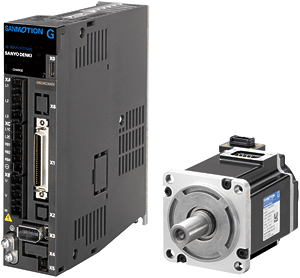
SANMOTION G AC Servo System is built not only for higher speed, but for motion that reaches position faster and stabilizes more cleanly. That matters in machines where throughput depends on how quickly the axis is actually ready for the next step.
SANMOTION G improves the speed control system frequency response to 3.5 kHz. The underlying control responsiveness is improved by increasing control cycle speed and current detection accuracy, then further improving torque control. In machine terms, that helps the axis react faster to commands and follow motion more sharply.
Settling is improved in a more specific way than just faster tuning. Using Advanced Tuning in the setup software, the system measures machine characteristics and compensates for friction and gravity, which are common causes of delayed settling. The whitepaper shows positioning settling time reduced to one third of the prior model. For machines with short repeated moves, that can translate directly into shorter cycle time.
Positioning stability is also supported by the encoder side. SANMOTION G uses a high-resolution batteryless absolute encoder, selectable up to 27-bit. Higher encoder resolution supports stable repeat operation and highly responsive positioning.
That combination is why SANMOTION G fits more than a generic high performance servo label. In X, Y, and Z applications, it supports machines that need fast response, accurate positioning, and short settling before the next transfer, cut, or inspection step. In rotary applications, it supports repeatable indexing and stable repeated motion where the machine cannot afford to wait for the axis to settle.
Explore the technology behind developing SANMOTION G servo system by downloading whitepaper.
In multi axis equipment, servo performance alone is not enough. The controller also has to coordinate the machine effectively.
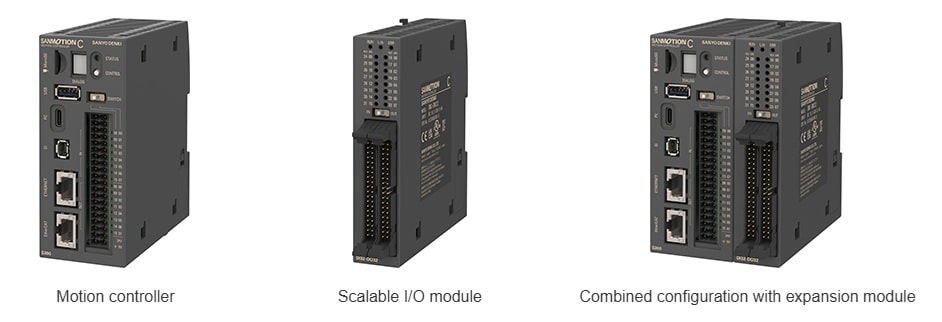
SANMOTION C S300 motion controller supports high precision multi axis control with a 1 ms cycle for up to 32 axes. It is well suited to machines that require coordinated control of multiple axes, whether those axes are linear, rotary, or a combination of both. Its CODESYS-enabled environment also helps simplify system integration for machine builders developing and managing more complex control architectures. In addition, it can record equipment operation video together with synchronized motion data from connected servo motors and servo amplifiers, helping improve troubleshooting and machine analysis.
For industrial automation equipment and other applications, motion performance depends on how accurately and consistently the machine can execute each move, not just on the highest speed listed in the specifications.
Consult with our motion expert when you have any questions.
This article is part of SANYO DENKI AMERICA’s motion control engineering knowledge base, sharing practical insights used in real-world servo and motion control applications.
Request a consultation for your customization needs. Our team will be in contact with you soon to provide further information and answer any questions you may have.