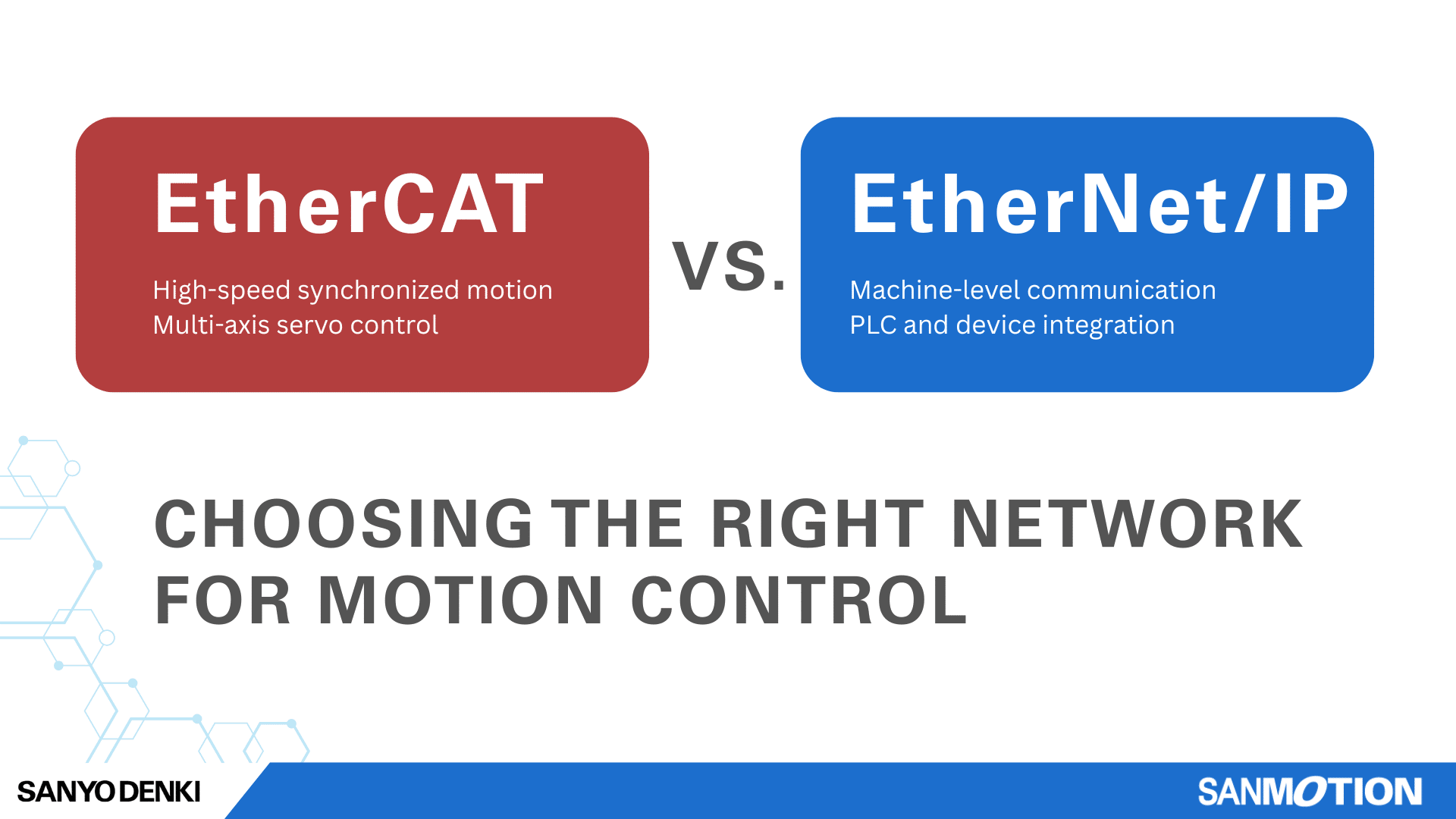
Featured image for EtherCAT vs. EtherNet/IP motion control network guide, comparing EtherCAT for synchronized servo axes with EtherNet/IP for industrial device communication.

EtherCAT vs. EtherNet/IP: Which is better for your application?

When selecting a network for industrial automation, it helps to start with a simple question:

What does the machine need most?

EtherCAT® and EtherNet/IP™ are both widely used Industrial Ethernet technologies, but they are designed for different strengths. For motion control systems, that difference matters. 

Quick Answer

If your application depends on fast, precise, synchronized motion, EtherCAT is often the stronger choice.

If your application is centered more on PLC communication, HMI communication, and standard Ethernet-based control networks, EtherNet/IP may be the better fit.

For many OEMs and equipment designers, the right answer depends on whether motion performance or broader control network integration is the top priority.


* EtherCAT® is a registered trademark and patented technology, licensed by Beckhoff Automation GmbH, Germany. EtherNet/IP™ is a trademark of ODVA, Inc. All other trademarks are the property of their respective owners.

What Is EtherCAT?

Why EtherCAT is often chosen for motion control

  • It is designed for real-time or near real-time performance.
  • It is well suited for motion control.
  • It uses lower payload requirements for data transfer.
  • It offers low jitter, which helps maintain consistent timing.
  • Devices typically have two ports, which can reduce the need for hubs and switches.

These characteristics make EtherCAT a strong option for machines that need smooth motion, repeatable performance, and stable communication timing.

What Is EtherNet/IP?

EtherNet/IP is an industrial Ethernet communication network built on standard Ethernet technology and the TCP/IP suite. It is commonly used in industrial automation systems that need standard Ethernet connectivity.

Why EtherNet/IP is widely used

  • It uses standard Ethernet hubs and routers.
  • It relies on standard Ethernet and internet technologies.
  • It is supported by many vendors.
  • It is often used for PLC communication and HMI communication.
  • It is a good fit for discrete I/O control

For customers with an established Ethernet-based control architecture, EtherNet/IP can be a practical fit for system-level communication.

EtherCAT vs. EtherNet/IP: The Main Difference

The main difference is not whether one network is “better.” The difference is what part of the machine the network is expected to control.

EtherCAT is often selected when communication timing directly affects motion quality. EtherNet/IP is often selected when the priority is PLC communication, HMI communication, discrete I/O, and integration into a standard Ethernet-based plant environment.

Diagram where Ethernet/IP and EtherCAT network would fit

When EtherCAT Is the Better Choice

EtherCAT is often the better fit when the machine depends on fast, predictable motion performance.

Choose EtherCAT when your application needs:

  • High-speed machine operation
  • Tight motion synchronization
  • Consistent communication timing
  • Stable control performance with low jitter

This can make EtherCAT a strong choice for machines where communication timing directly affects motion quality. For applications such as automated assembly equipment, packaging systems, indexing systems, and inspection equipment, synchronized motion and repeatable positioning can directly influence cycle time, accuracy, and overall machine performance.

When EtherNet/IP Is the Better Choice

EtherNet/IP is often the better fit when the main goal is broader control communication across a standard Ethernet-based environment.

Choose EtherNet/IP when your application needs:

  • PLC communication
  • HMI communication
  • Discrete I/O control

For many OEMs, system integrators, and end users, EtherNet/IP is a practical choice when overall network familiarity and plant integration are the main priorities.

How SANYO DENKI Supports Both Approaches

In many machines, the real question is not simply EtherCAT or EtherNet/IP. The question is how to combine precise motion control with practical system integration.

SANYO DENKI supports EtherCAT communication on SANMOTION R and SANMOTION G servo amplifiers for applications that require synchronized servo control.

SANMOTION R and G servo drives connected through EtherCAT, showing a multi-axis connection example with drives supporting up to 4 axes each and controller options for up to 32 or 64 axes.

SANMOTION G servo drive EtherCAT wiring and configuration diagram showing USB setup connection, host controller link, daisy-chain to next amplifier, and GPIO interface.

SANYO DENKI also offers both EtherCAT and EtherNet/IP on S100 and S200 controllers.

The Controller can act as a bridge between the PLC and R or G amplifiers in EtherNet/IP-related applications.

Industrial network comparison showing Regular Ethernet, EtherNet/IP PLC, and EtherNet/IP peripheral configurations with HMI, motor drives, PLC, and EtherCAT integration.

This gives machine builders and manufacturers flexibility when they need to balance motion performance with system integration requirements.

Find the Right SANMOTION G Solution for Your Next Machine

EtherCAT and EtherNet/IP are not interchangeable answers to the same question. EtherCAT is often the stronger starting point when motion timing, synchronization, and low jitter are critical. EtherNet/IP is often the stronger starting point when PLC communication, HMI communication, I/O, and plant network integration are the main priorities.

For machine builders, the best choice starts with the machine requirement, not the protocol name.

Ready to see how these capabilities can optimize your next machine design? The engineering team at SANYO DENKI AMERICA, along with our specialized network of reps firms and distributors, is available to consult on your specific motion control challenges.

Contact us today to discuss your application parameters, or explore the comprehensive SANMOTION G lineup online to specify the exact configuration that matches your requirements.

SANMOTION G servo system by SANYO DENKI

This article is part of SANYO DENKI AMERICA’s motion control engineering knowledge base, sharing practical insights used in real-world servo and motion control applications.


Request A Consultation

Request a consultation for your customization needs. Our team will be in contact with you soon to provide further information and answer any questions you may have.