




Motion Control Technology by SANYO DENKI AMERICA
motioncontrol.blog is operated by SANYO DENKI AMERICA and shares motion control engineering insights for industrial applications.
Inertia refers to how strongly the motor’s rotating parts, mainly the rotor, and encoder and brake components, resist changes in speed. That influences how the axis responds to motion commands and helps explain why different motor types can behave differently in the same application.
In servo motors, this refers to rotational inertia, which describes how strongly a rotating object resists changes in speed. The higher the inertia, the harder it is to speed up or slow down. The lower the inertia, the easier it is to change speed.
This matters in motion control because it affects how the motor responds during acceleration, deceleration, repeated positioning, and frequent direction changes.
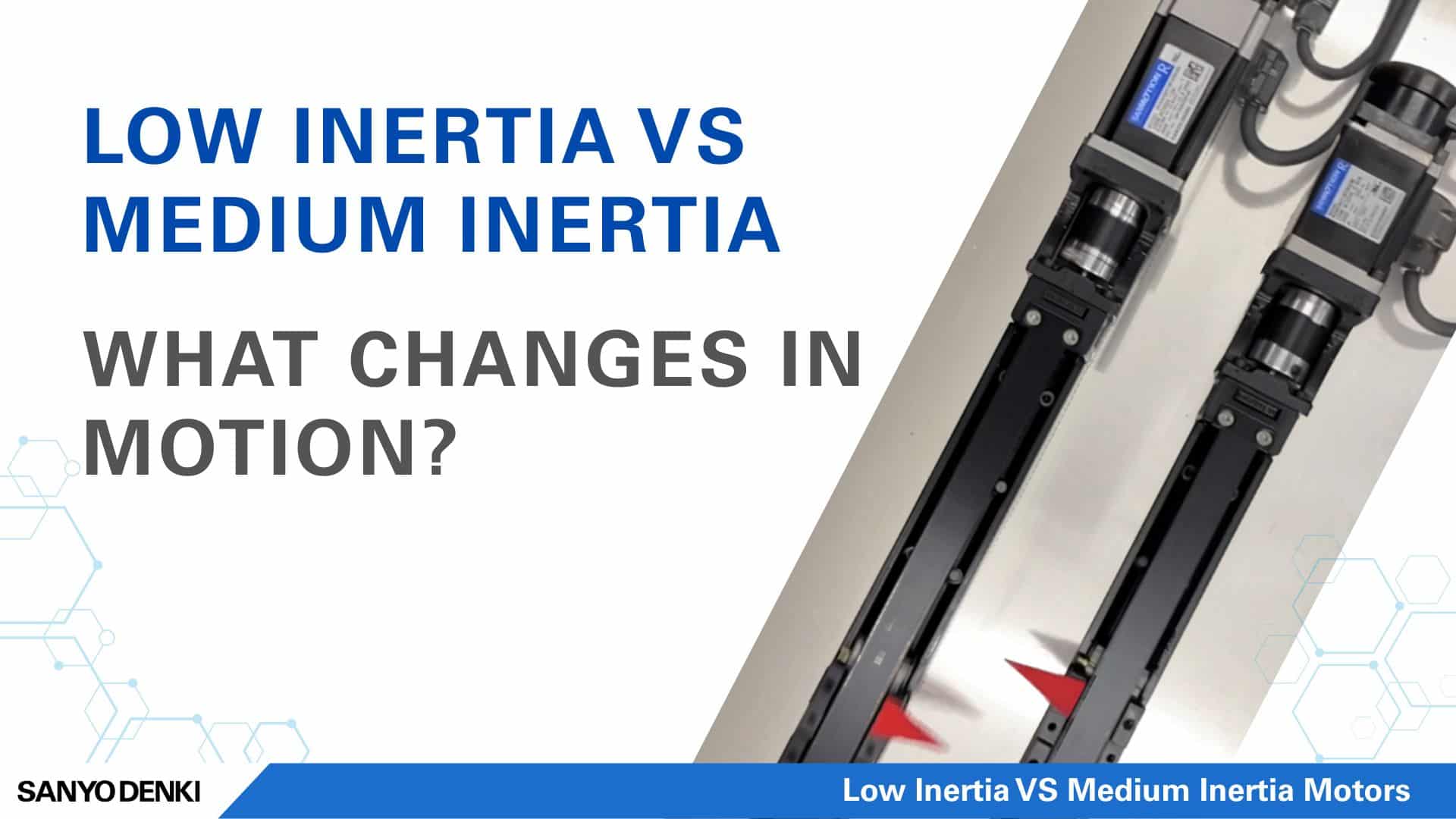
In a side-by-side comparison shown in the video above, using a specific motion profile, a low inertia motor reaches its destination noticeably faster than a medium inertia counterpart.
What causes this difference? The short answer is inertia of the rotor, and other rotating components within the motor.
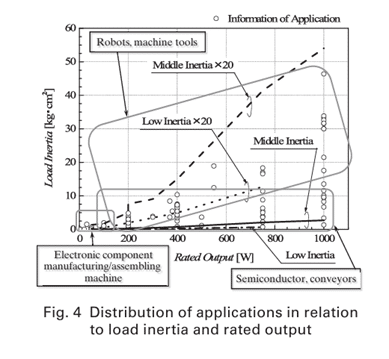
Inertia affects more than just how quickly a motor starts or stops. According to SANYO DENKI Technical Report No. 47, motor inertia affects acceleration, response under load, and how well a motor fits the application.
To help select the right motor, engineers look at the inertia ratio, which compares the load inertia to the motor’s rotor inertia .
As a general selection guideline, SANYO DENKI recommends provisionally selecting a motor where the load inertia is 10 times or less than the motor’s rotor inertia.
Reference: SANMOTION G catalog P109 Section 4.
A low inertia servo motor resists speed change less, which can support quick response in repeated short moves and frequent start-stop motion.
A medium inertia servo motor has a higher rotor inertia than a low inertia motor and is often used where the motor must drive a larger or more demanding mechanical load.
Rather than thinking of one as better, it is more useful to think of them as different application fits.
| Feature | Low Inertia Motors | Medium Inertia Motors |
|---|---|---|
|
Primary Characteristic |
Lower resistance to speed changes |
Higher rotor inertia for stability |
|
Best For |
Extreme agility and rapid cycling |
Large or demanding mechanical loads |
|
Key Advantage |
Faster response in short, repeated moves |
Better fit for certain load conditions |
The most suitable motor inertia characteristic depends on the load, motion profile, and machine requirements. In general, however, some applications are more commonly associated with low inertia servo motors, while others may be better suited to medium inertia servo motors.
Low inertia servo motors are often used in:
Robot Arm example: Low Inertia Servo Motors and Gear Heads: A Powerful Combination
Medium inertia servo motors are often used in:
The better choice depends on how the motor characteristics match the actual motion requirement.
Inertia should be evaluated within the context of the full application, including load conditions and settling requirements. SANYO DENKI AMERICA helps customers evaluate the ideal motor and amplifier combination for their specific motion control needs.
This article is part of SANYO DENKI AMERICA’s motion control engineering knowledge base, sharing practical insights used in real-world servo and motion control applications.
Request a consultation for your customization needs. Our team will be in contact with you soon to provide further information and answer any questions you may have.