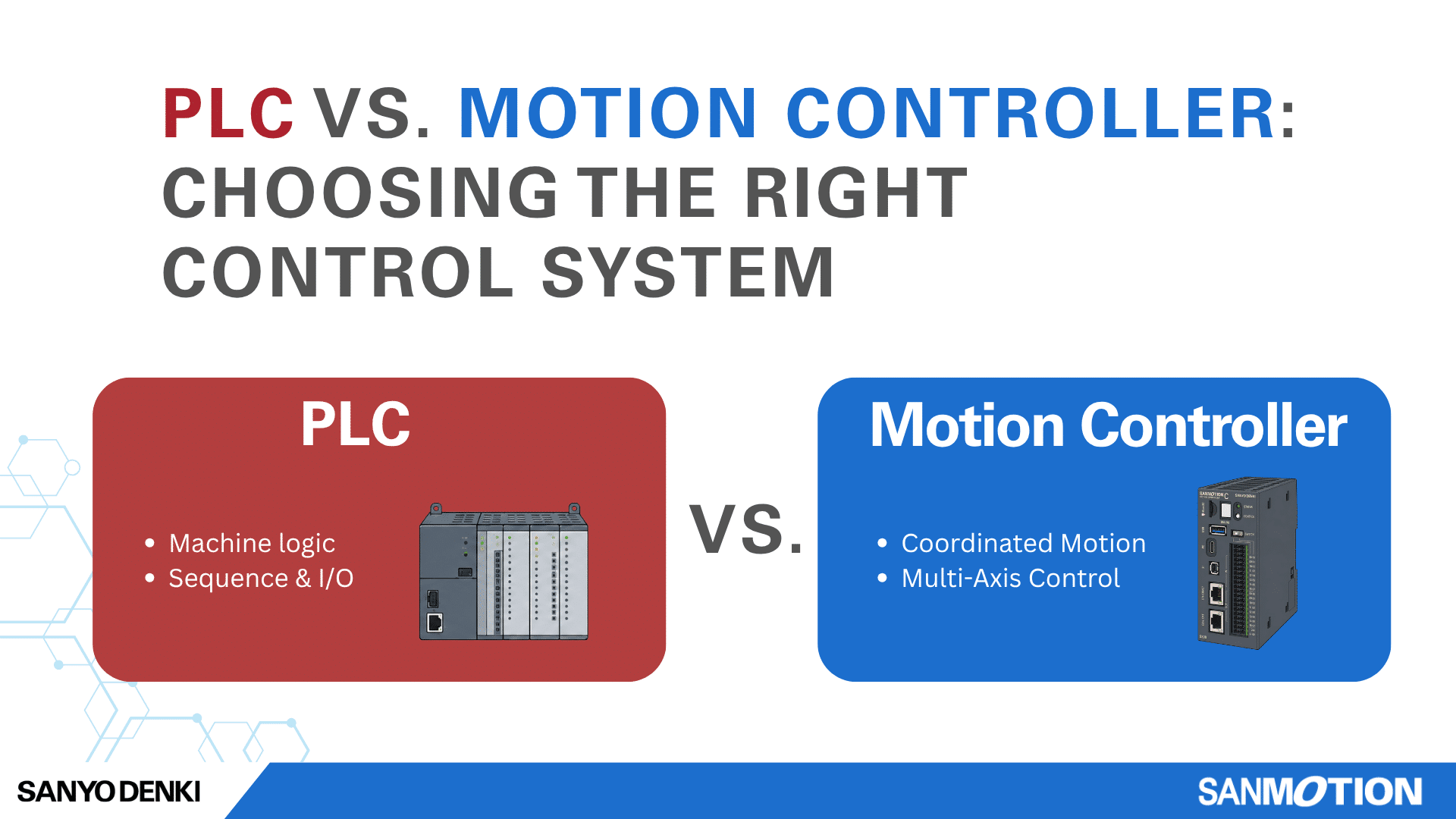
Illustration comparing a PLC and a SANMOTION C motion controller for machine-control architecture selection.

When designing an automated machine, the controller decision is not always as simple as choosing between a PLC and a motion controller. Many PLCs can command servo axes, and many motion controllers can also manage sequence logic, I/O, and robot control.

The more useful question is: What must the machine control, and how closely must its axes work together?

The answer usually leads to one of three architectures: a PLC with integrated motion, a PLC working with a separate motion controller, or an integrated controller managing machine logic, motion, and robotics.

Quick Answer: PLC or Motion Controller?

A PLC is often sufficient when the machine primarily depends on sequence control, I/O, and relatively independent positioning axes. A motion controller becomes more important when multiple axes must maintain precise position, speed, or timing relationships. Applications involving interpolation, camming, tracking, kinematics, or robot coordination require advanced motion control functions.

The number of motors alone does not determine the right architecture. A machine with ten independent axes may require less advanced control than a machine with three tightly synchronized axes.

1. PLC, Motion Controller, and Advanced Motion Control

Three Common Machine-Control Architectures

Architecture 1: PLC with Integrated Motion

In this architecture, one PLC manages the machine sequence, I/O, and servo commands.
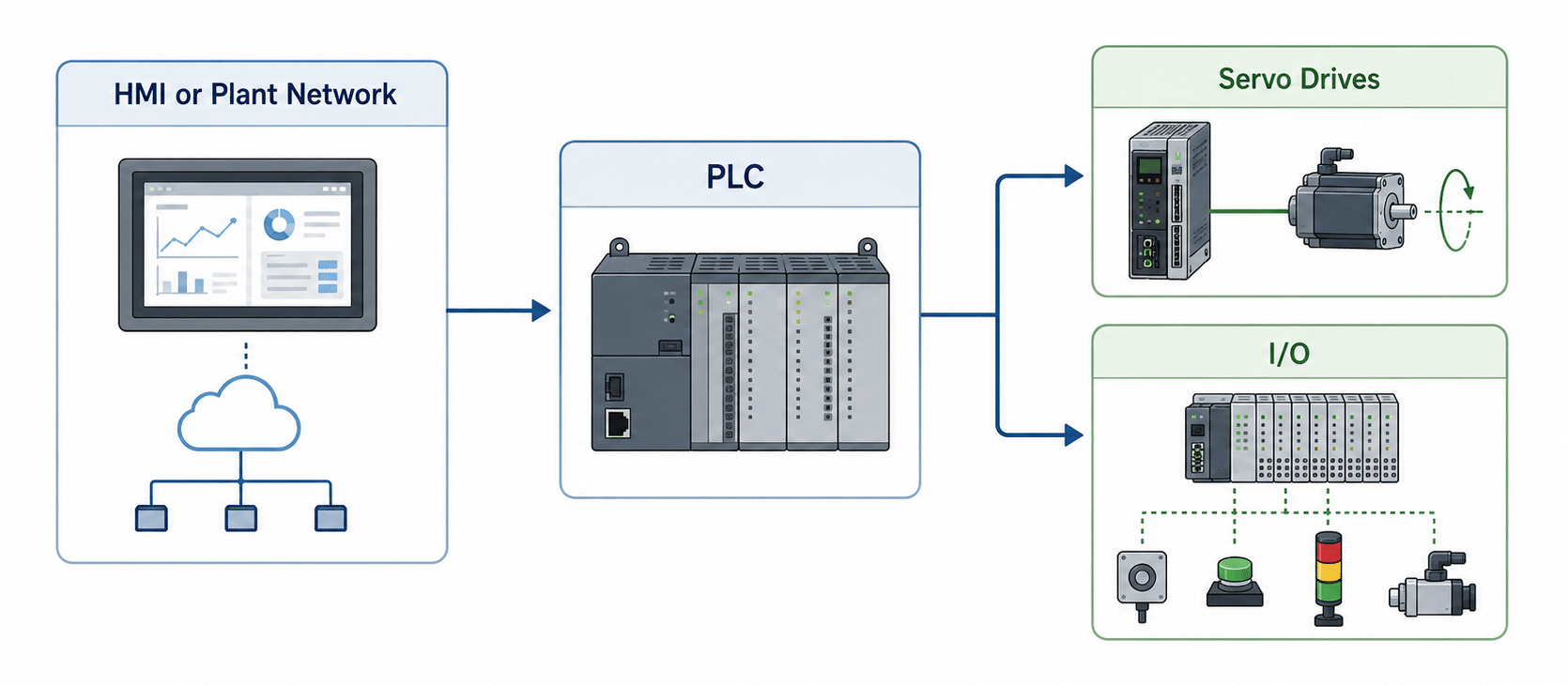
PLC with integrated motion architecture connecting an HMI or plant network to servo drives and I/O.

HMI or plant network -> PLC -> Servo drives and I/O

Best fit: Axes operate mostly independently, motion profiles are relatively simple, the customer has an established PLC standard, or one development environment is preferred.

The primary advantage is simplicity. The limitation appears when machine performance begins to depend on consistently timed relationships between several axes.

Architecture 2: PLC Plus Motion Controller

In this architecture, the PLC controls the overall machine while a separate motion controller executes the time-critical trajectories.
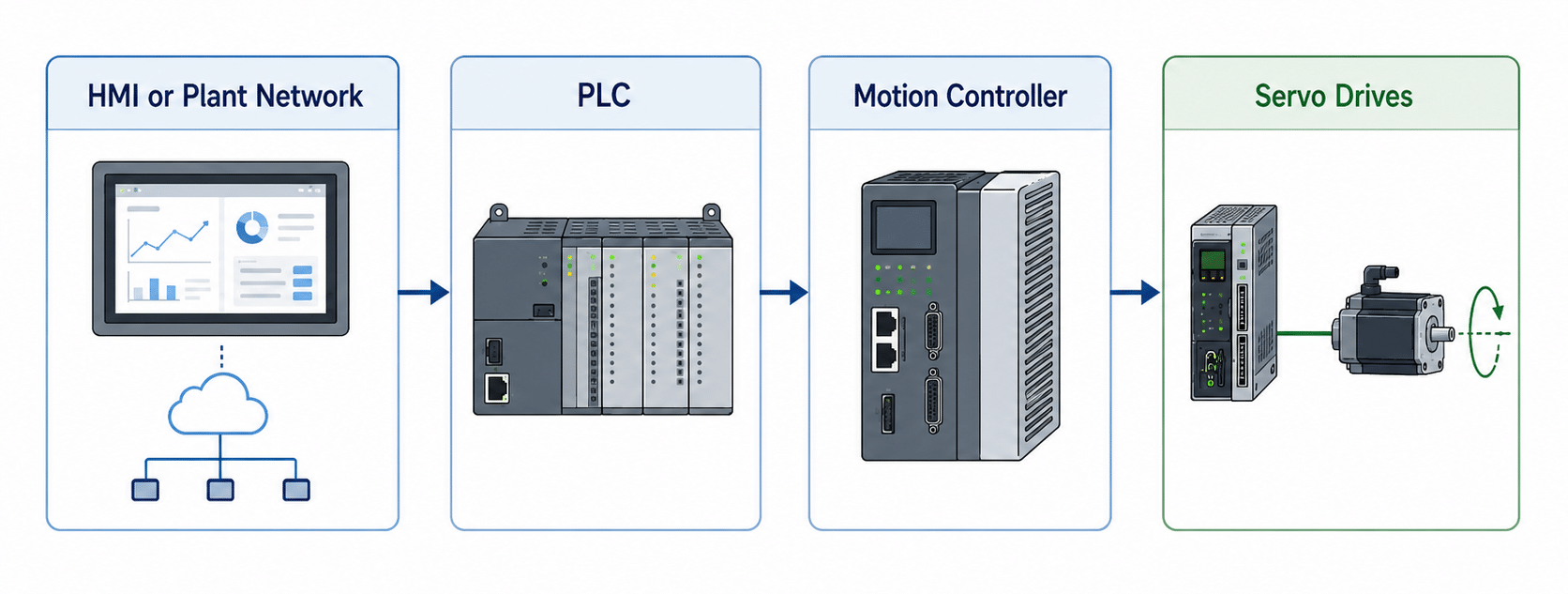
PLC and motion controller architecture connecting an HMI or plant network to servo drives.

HMI or plant network -> PLC -> Motion controller -> Servo drives

Best fit: The facility requires a specific PLC platform, but the machine contains a complex motion subsystem with tightly coordinated axes. The PLC handles supervisory commands and machine status, while the motion controller performs detailed motion calculations locally.

One practical example is an EtherNet/IP PLC for plant-level control with a SANMOTION C controller managing drives over EtherCAT. See EtherNet/IP Motion Control with SANMOTION C for EtherCAT Precision.

Architecture 3: Integrated Machine and Motion Controller

An integrated controller combines sequence logic, motion control, I/O, and sometimes robot control within one platform.
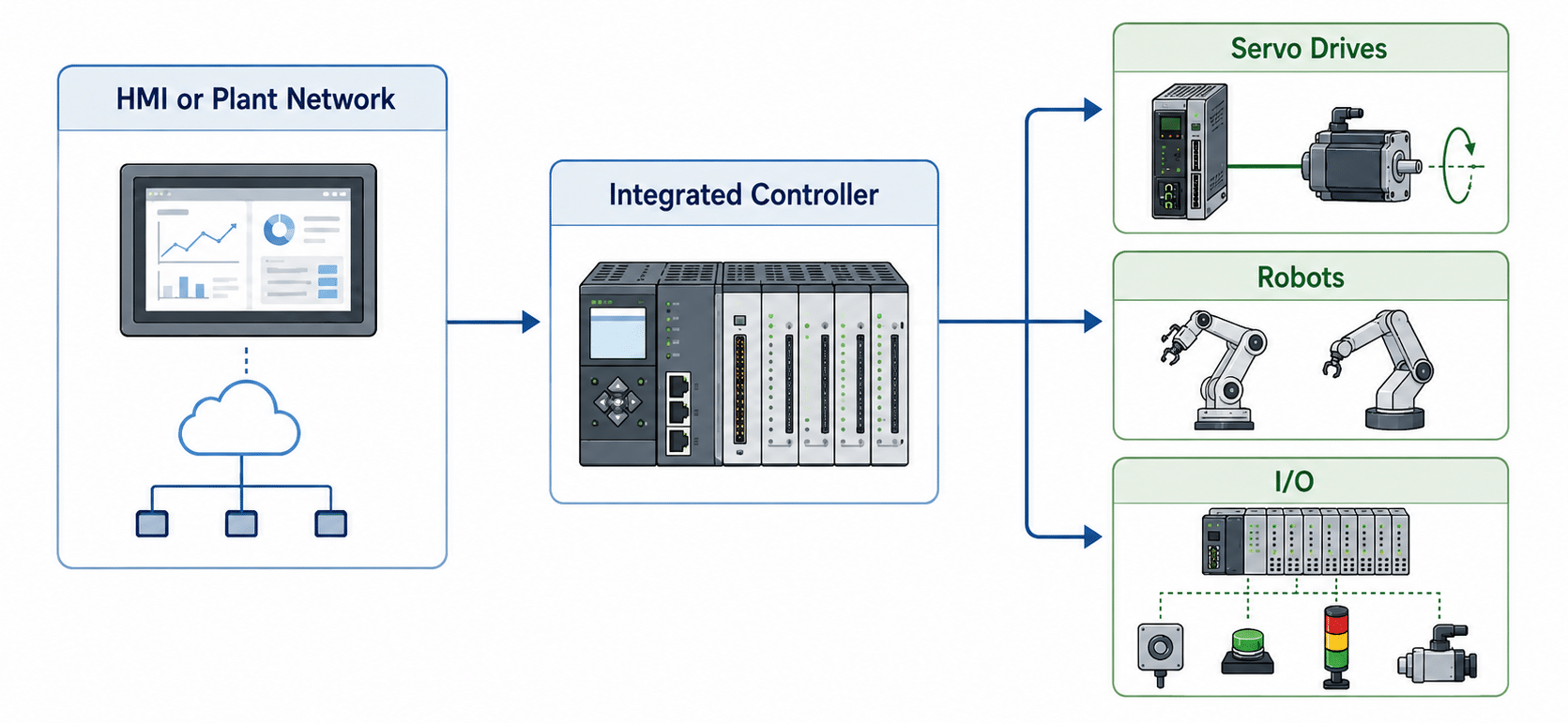
Integrated machine and motion controller architecture connecting an HMI or plant network to servo drives, robots, and I/O.

HMI or plant network -> Integrated controller -> Servo drives, robots, and I/O

Best fit: Motion is central to the complete machine, multiple axes must operate as one system, robots and machine axes must be synchronized, or reducing controller count and inter-controller communication is a priority.

Integration does not eliminate plant-level connectivity. The controller may still exchange information with a plant PLC, HMI, SCADA platform, or manufacturing system.

For an example that combines machine, motion, and robot control, see Strengthen Equipment Design with the SANMOTION C S500 3-in-1 Motion Controller.

Network selection is a separate decision: the architecture determines where logic and motion calculations take place, while the network determines how devices exchange commands and data. See EtherCAT vs. EtherNet/IP: Choosing the Right Network for Motion Control.

2. Select the Architecture by Axis Relationships

The architecture decision should begin with three questions:

– Do the axes complete separate positioning tasks, or must they move together as one system?

– Does the facility require a plant-standard PLC while the machine needs a specialized motion subsystem?

– Should logic, coordinated motion, I/O, and robotics operate within one development environment?

A PLC-centered architecture may be sufficient for independent positioning and sequence control. A PLC plus motion controller can preserve a plant standard while adding coordinated motion. An integrated controller may be the better fit when logic, motion, I/O, and robotics must operate within one control environment.

For motion-intensive equipment, diagnostic visibility can help engineers understand intermittent timing or synchronization problems. See Smart Motion for Multi-Axis Machines: Troubleshoot with Proof.


3. Choosing the Right SANMOTION C Motion Controller

When an application moves beyond basic positioning, the key question is which motion functions must be coordinated and where they should execute. SANYO DENKI’s SANMOTION C lineup supports architectures ranging from compact motion control and connected machine monitoring to high-performance multi-axis control and integrated machine, motion, and robot control.


Product ImageSANMOTION C SeriesMaximum Controllable AxesPrimary RoleKey CapabilitiesTypical Architecture Fit
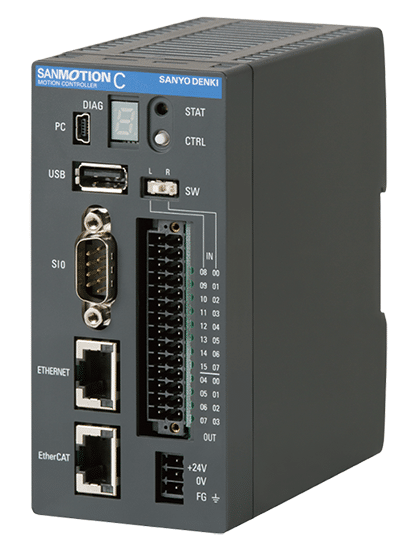
SANMOTION C S100 motion controllerS1008 axesCompact machine and motion controlSequence control, positioning, interpolation, electronic cam and gearing, and robot control depending on modelCompact machines and dedicated motion subsystems
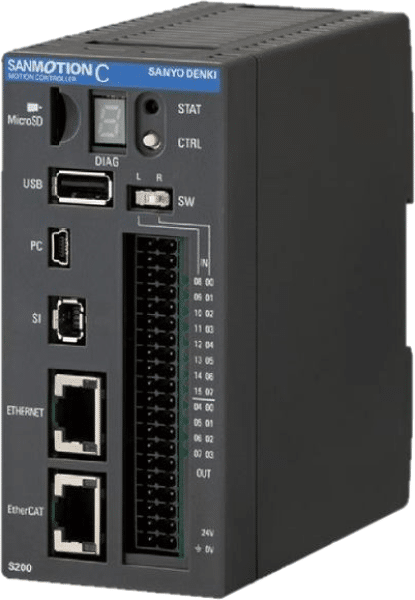
SANMOTION C S200 IoT motion controllerS2008 axesIoT-focused machine and motion controlMotion control plus equipment data collection, remote monitoring, data storage, camera connectivity, and remote maintenance functionsConnected machines requiring motion control plus IoT, monitoring, and serviceability
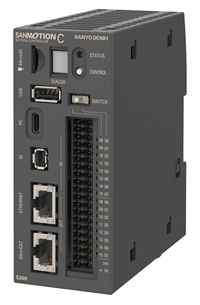
SANMOTION C S300 multi-axis motion controllerS30032 axesHigh-performance multi-axis machine controlUp to 32 axes, 1 ms control cycle, synchronized multi-axis motion, scalable I/O, industrial communications, and synchronized motion and video diagnosticsHigher-axis-count machines requiring coordinated motion and integrated machine control
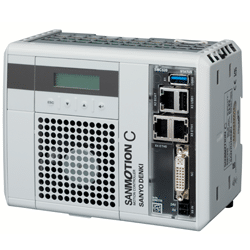
SANMOTION C S500 motion and robot controllerS50064 axesAdvanced machine motion and robot controlLarge-scale multi-axis control, trajectory control, multiple robot configurations, and simultaneous robot controlComplex equipment combining machine axes and robotics within one coordinated control environment

The SANMOTION C lineup allows machine builders to select the controller around the machine architecture, axis relationships, synchronization requirements, connectivity, and robot complexity rather than axis count alone.

Not sure which SANMOTION C controller is the right fit for your machine? Contact SANYO DENKI AMERICA for selection support. Our team can help review your control requirements and identify the SANMOTION C configuration that best matches your application.


This article is part of SANYO DENKI AMERICA’s motion control engineering knowledge base, sharing practical insights used in real-world servo and motion control applications.

Request A Consultation

Request a consultation for your customization needs. Our team will be in contact with you soon to provide further information and answer any questions you may have.